

Snus is a moist, smokeless tobacco product from Sweden that you tuck under your upper lip. It is steam-pasteurised rather than fermented, which keeps certain harmful compounds far lower than in American dip or chewing tobacco. It is sold loose or in small portion bags, it is banned for sale across most of the EU, and it is the reason Sweden has the lowest smoking rate in Europe.
If you have arrived here from a search, you probably want one of three things: to understand what the stuff actually is, to work out whether it is different from the nicotine pouches you have seen on a shop counter, or to figure out how to get hold of it. This guide covers all three, in that order.
One thing before we start, and I mean it. If you do not already use nicotine, do not start. Not with snus, not with pouches, not with anything. This site exists for people who already smoke or already use nicotine and want to make better decisions about it. Nothing here is an invitation.
What snus actually is
Snus is finely ground tobacco, water, salt, a pH regulator (usually sodium carbonate) and flavouring. That is close to the whole recipe. The mixture is heat-treated in a process much like food pasteurisation, cooled, flavoured, and then either packed loose in a tin or portioned into small teabag-like pouches.
The thing that separates it from almost every other smokeless tobacco on earth is that pasteurisation step. American moist snuff and chewing tobacco are fermented. Fermentation encourages the formation of tobacco-specific nitrosamines, a group of compounds that includes some of the more studied carcinogens in tobacco. Swedish manufacturers pasteurise instead, and the nitrosamine levels in the finished product come out dramatically lower as a result.
You do not chew it and you do not swallow it. It sits between your gum and your upper lip, usually for somewhere between twenty minutes and an hour, and the nicotine crosses the lining of your mouth into your bloodstream.
The words people mix up
The vocabulary in this category is a mess, largely because marketing departments have borrowed each other’s words for twenty years. Here is the honest version:
| Term | What it actually means |
|---|---|
| Snus | Swedish-style pasteurised moist tobacco. Contains tobacco leaf. Loose or portioned. |
| Nicotine pouch | No tobacco leaf at all. Nicotine plus plant fibre, sweeteners and flavour in a white bag. ZYN, VELO, on! and the rest. |
| Dip / moist snuff | American, fermented, loose. Spat, not swallowed. A different product with a different risk profile. |
| Chewing tobacco | Loose leaf, actually chewed. Different again. |
| Snuff | Confusingly, in British English this usually means dry powdered tobacco that you sniff. |
If someone tells you they use “snus” and they are holding a can of ZYN, they are using a nicotine pouch. The distinction matters legally, because tobacco-free pouches fall under different rules in most countries, and it matters practically, because they behave differently in your mouth.
How snus is made
The production process has five stages, and each one changes the finished product in a way you can taste.
- Grinding. Tobacco leaf, usually air-cured or sun-cured, is ground to a specified coarseness. A coarse grind gives a slower, rounder release. A fine grind hits faster.
- Mixing. Ground tobacco is blended with water, salt and sodium carbonate. The salt is a preservative and a flavour component. The sodium carbonate raises the pH, which is what makes the nicotine more readily absorbed through the gum.
- Heat treatment. The mixture is heated, typically for somewhere between a day and several days, at temperatures that kill off microorganisms without fermenting the tobacco.
- Flavouring and cooling. Flavour is added after the heat step, because heat would drive most of it off. Bergamot is the classic. Juniper, citrus, mint, liquorice and whisky notes are all common.
- Portioning and packing. Either straight into a tin as loose snus, or measured into small bags of cellulose fibre and packed.
The formats, and which one you actually want
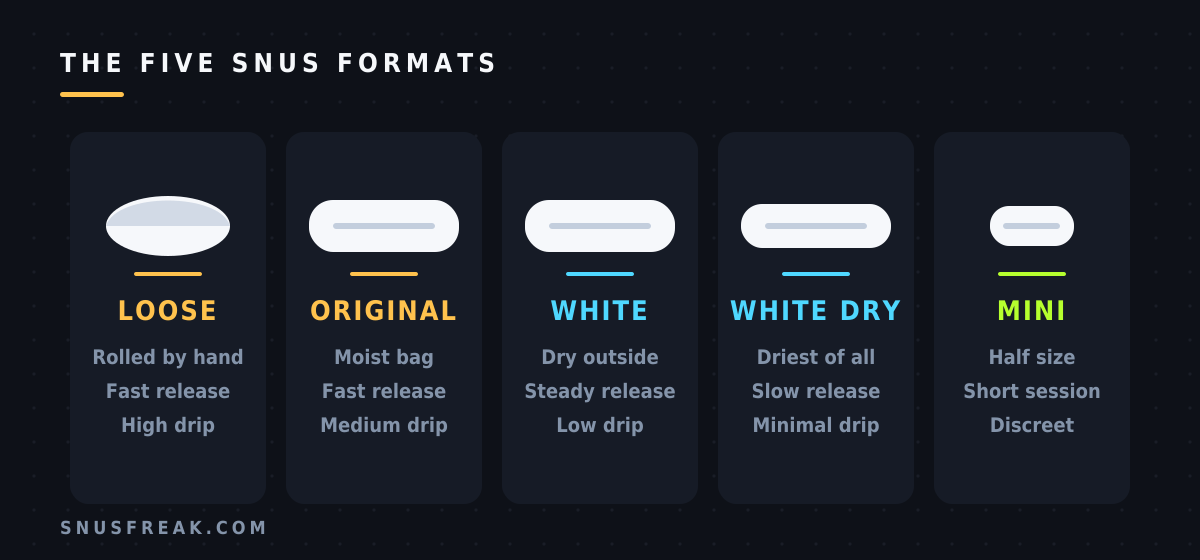
Loose snus
Sold as a mass in a tin. You take a pinch, roll it into a cylinder with your fingers or a dispenser, and place it. It is the traditional format and it has the most devoted following, mainly because you control the size of the portion exactly. It is also messy, it takes practice, and it is not something to try for the first time in public.
Original portion
The tobacco is moistened before portioning, so the bag arrives damp and slightly darker. Flavour and nicotine come through quickly, and there is noticeably more drip. This is the classic portion format and still the biggest seller in Sweden.
White portion
The bag is only lightly moistened on the inside, so the outside stays dry. The release is slower and steadier, the drip is much lower, and the pouch holds its shape for longer. If you are coming to snus from nicotine pouches, this will feel most familiar.
White dry
Drier still. Very little drip, very slow release, and the pouch stays almost unchanged in your lip for the whole session. Popular with people who want discretion above everything.
Slim, mini and large
These are shape descriptions, not strength descriptions. Slim portions are longer and narrower, which most people find sits more comfortably. Mini is roughly half the size and correspondingly discreet. Large is the traditional chunky format.
Strength: the number on the can is not the whole story
Snus strength is normally given as milligrams of nicotine per gram of product, written as mg/g. Nicotine pouches are usually labelled as milligrams per pouch. These are not the same measurement and cannot be compared directly, which is the single most common mistake people make when switching between the two.
To convert roughly: multiply the mg/g figure by the weight of the portion in grams. A standard portion weighs around 0.8 to 1.0 g, so an 8 mg/g snus in a 1 g portion delivers roughly 8 mg per portion in content terms.
But content is not delivery. How much nicotine actually reaches your bloodstream depends on the pH of the product, how long you keep it in, and your own tolerance. Two products with identical labels can feel completely different. I would not put much faith in the number alone.
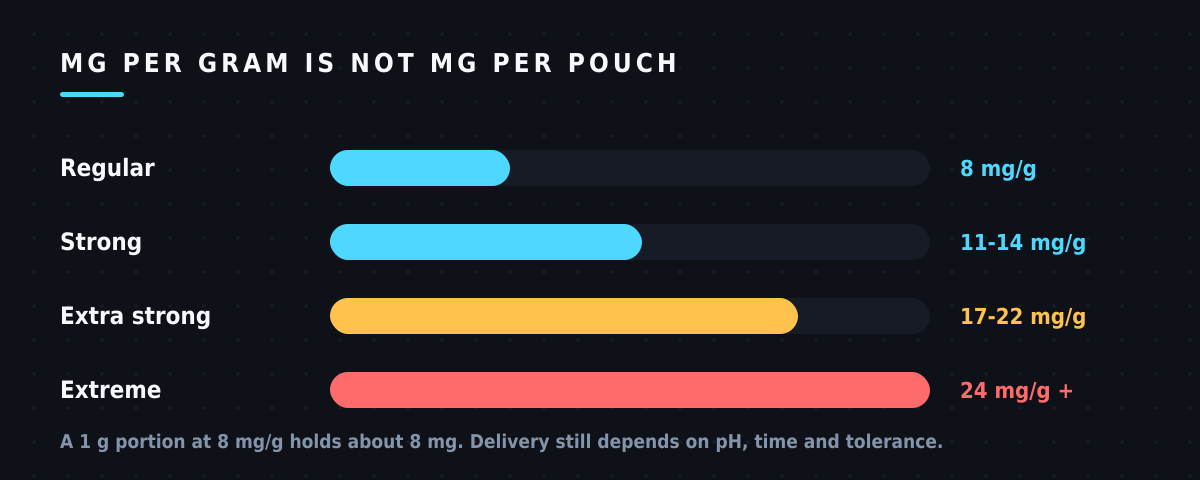
As a rough map of the market: regular strength sits around 8 mg/g, strong around 11 to 14 mg/g, extra strong around 17 to 22 mg/g, and a handful of extreme products go far beyond that. If you are new to this and switching from cigarettes, regular or strong is where to start. The extreme end of the market is not a badge of honour, it is a fast route to feeling genuinely unwell.
What is in it, and what GOTHIATEK means
Since 2000, Swedish Match has published a voluntary quality standard called GOTHIATEK, which sets maximum limits for a list of undesirable compounds and requires a full declaration of contents in the manner of food labelling.
The limits are specific. Nitrite is capped at 3.5 mg/kg. The nitrosamines NNN and NNK together are capped at 0.95 mg/kg. Lead is capped at 1.0 mg/kg, cadmium at 0.5 mg/kg and arsenic at 0.25 mg/kg. Aflatoxins are capped at 2.5 µg/kg, benzo(a)pyrene at 1.25 µg/kg, N-nitrosodimethylamine at 2.5 µg/kg and formaldehyde at 7.5 mg/kg.
Two caveats worth stating plainly. GOTHIATEK is a manufacturer’s own standard, not a government regulation, and it applies to that manufacturer’s products. Separately, Swedish law has set limits for NNN+NNK and benzo(a)pyrene since 2016, following a WHO recommendation made in 2009. A can that carries the GOTHIATEK mark tells you something real about what is in it. A can that does not is not automatically worse, but you have less to go on.
Why you cannot buy it in most of Europe
The European Union banned the sale of snus in 1992, under a directive aimed at oral tobacco products. When Sweden joined the EU in 1995 it negotiated an exemption as part of its accession terms, and that exemption still stands. Snus can be made and sold legally in Sweden. It cannot legally be sold in the other member states, though possession and personal import for your own use is treated very differently from country to country.
Norway is not in the EU and snus is legal and widely used there. Switzerland lifted its own ban in 2019. The United Kingdom’s position changed after it left the EU, but the picture there is complicated enough to deserve its own page.
The United States is a separate story again. Snus is legal to sell where it has passed the FDA’s premarket review, and in 2019 the FDA authorised a set of General Snus products to be marketed with a modified risk claim — the first smokeless tobacco products ever to receive one.
The practical consequence for most readers outside Sweden and Norway: you will be ordering online from a Swedish or Norwegian retailer, and what happens at your border is the thing that actually determines whether it arrives.
What the evidence says about risk
This is the part where most sites either cheerlead or scaremonger, so let me be careful.
Snus is not safe. Nicotine is addictive, and I say that as someone who is dependent on it. No tobacco or nicotine product is risk-free, and the lowest-risk option is not using any of it.
What the research does show is that the risk profile is meaningfully different from smoking. There is no combustion, so there is no smoke, no tar and no carbon monoxide. The large Swedish cohort studies have consistently found no increase in lung cancer risk among snus users, which is unsurprising given nothing is inhaled. The evidence on oral cancer in Swedish snus users is far weaker than the equivalent evidence for smoking, though it is not absent and it is still debated. The pancreatic cancer question remains genuinely contested, with studies pointing in different directions.
Effects that are well documented and less dramatic: local gum irritation and recession at the placement site, and short-term increases in heart rate and blood pressure.
The population-level argument, usually called the Swedish Experience, is that a large-scale shift from cigarettes to snus is why Sweden’s daily smoking rate had fallen to 5.4% by 2024, against an EU average of around 24%. Whether that is mainly down to snus or mainly down to decades of tobacco control policy is argued about by serious people on both sides. It is the strongest single piece of evidence in the harm reduction case, and it is also the most contested.
None of this is medical advice, and I am not qualified to give any. If you are trying to stop smoking, a doctor or a cessation service has options I cannot tell you about.
Snus or nicotine pouches?
If you are choosing between them today, the honest summary is this.
Pouches are easier to get almost everywhere, come in a far wider range of flavours, leave no stain, and have essentially no tobacco taste. They are also the format nearly every new product is launched in, so the market moves faster.
Snus has a flavour depth that pouches have not managed to copy — the tobacco itself is doing work that plant fibre and flavouring cannot replicate. It is also harder to buy, it will stain a white bag over time, and the taste is an acquired one.
My view, for what it is worth: if you are switching from cigarettes and you want the nearest thing to what you are used to, try snus. If you want convenience, discretion and choice, pouches. Neither answer is wrong, and plenty of people keep both in a drawer.
Frequently asked questions
Do you swallow the saliva?
Most long-term users do, and it is generally considered normal for Swedish snus. Some people find it upsets their stomach, particularly with original portions, which produce more drip. White and white dry portions produce far less.
How long do you keep a portion in?
Between twenty minutes and an hour is typical. Most of the nicotine has been delivered within the first half hour.
Does it stain your teeth?
Original portion snus can, over time, because the moist tobacco is in direct contact with the tooth surface. White portions much less so. Rotating where you place it helps your gums more than it helps your teeth.
Does snus go off?
It has a best-before date, typically a few months from manufacture, and it is refrigerated in Swedish shops for a reason. Kept cool it stays fresh far longer; kept warm it dries out and the flavour flattens. It can be frozen.
Is snus the same as ZYN?
No. ZYN is a nicotine pouch and contains no tobacco leaf. This is the single most common confusion in the category.
Can you fly with it?
Generally yes in hand luggage, but the rules that matter are the ones at your destination, not at your departure airport. Several countries that permit possession do not permit import.