

A nicotine pouch is a small white bag of plant fibre, nicotine, sweetener and flavouring that you tuck under your upper lip. It contains no tobacco leaf at all, which is what separates it from snus and what puts it under different laws in most of the world. The nicotine crosses the lining of your mouth over twenty to sixty minutes. There is no smoke, no spitting and nothing to inhale.
This is the page I wish had existed when I started. It covers what is actually inside a pouch, how the formats differ, how to read a strength label that brands deliberately make confusing, where they are legal, and what the evidence says about risk.
Before anything else. If you do not already use nicotine, do not start. This site is for people who already smoke or already use nicotine and want to make better decisions about it. Nothing here is an invitation.
What is actually inside
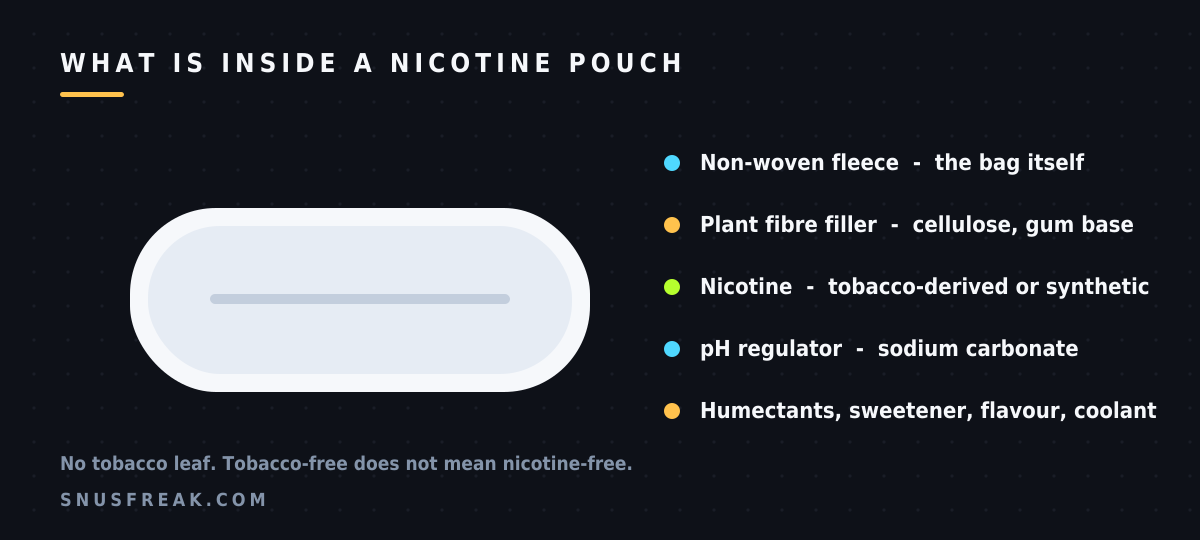
Open a pouch and you find surprisingly little. A typical formulation is:
- Plant fibre — usually microcrystalline cellulose, sometimes with gum base. This is the bulk. It does nothing pharmacologically; it is there to give the pouch structure and hold everything else.
- Nicotine — either extracted from tobacco and purified until no tobacco material remains, or synthesised in a laboratory. Chemically the two are the same molecule, though not always in the same ratio of isomers.
- A pH regulator — usually sodium carbonate. This is the quiet workhorse. It raises the pH so more of the nicotine is in its freebase form, which crosses the lining of your mouth far more readily.
- Humectants — propylene glycol or glycerol, to stop the pouch drying out.
- Sweeteners and flavouring — acesulfame K or sucralose, plus the flavour compounds themselves.
- Cooling agents — WS-3, WS-23 or menthol in anything that claims to be “ice”, “freeze” or “frost”.
The bag itself is a non-woven fleece, and its quality matters more than people expect. A rough fleece will irritate your gum within an hour; a soft one you will forget is there.
Why “tobacco-free” does not mean “nicotine-free”
This confuses people constantly. Tobacco-free refers to the absence of tobacco leaf, not the absence of nicotine. A tobacco-free pouch is still a nicotine product and is still addictive. What the absence of leaf does change is the chemistry: no tobacco material means no tobacco-specific nitrosamines, which is a genuine difference from snus, and it means a different legal classification in most countries.
The formats
| Format | Typical size | What it is for |
|---|---|---|
| Slim | Long and narrow, ~0.7 g | The default. Sits comfortably along the gum line and stays put. |
| Mini | About half the size, ~0.4 g | Discretion. Shorter sessions, less nicotine, almost invisible. |
| Large / regular | Chunkier, ~1.0 g | More material, more flavour, more presence under the lip. |
| Dry | Any size, low moisture | Slow release, minimal drip, holds its shape for the whole session. |
| Moist | Any size, pre-moistened | Faster flavour and nicotine, noticeably more drip. |
Moisture matters more than size. A moist slim pouch and a dry slim pouch with identical labels behave nothing alike: the moist one hits within two minutes and fades by twenty, the dry one takes ten minutes to get going and is still working at forty-five.
Strength, and the label trick
Pouches are labelled in milligrams of nicotine per pouch. Snus is labelled in milligrams per gram. These are different measurements and comparing them directly is the single most common mistake in this category.
Worse, brands do not agree with each other. A 6 mg pouch from one manufacturer can deliver noticeably more than a 6 mg pouch from another, because delivery depends on pH, moisture, fleece and how long you keep it in — not just on how much nicotine is in the bag. The number on the can tells you content, not dose.
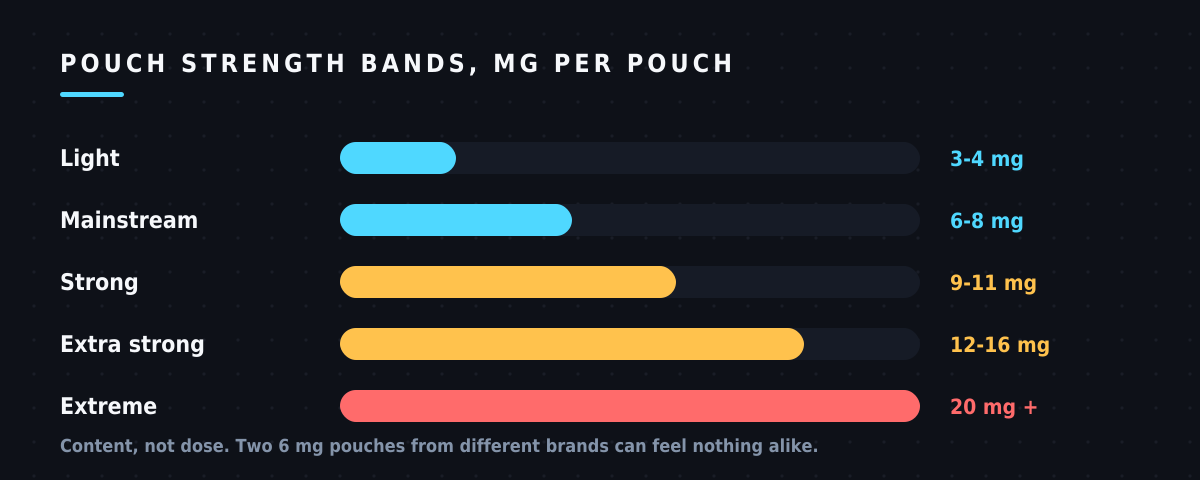
The practical bands, as the market actually uses them:
- 3–4 mg — light. Sensible for a first pouch, or for someone stepping down.
- 6–8 mg — the mainstream. Most people switching from cigarettes land here and stay.
- 9–11 mg — strong. Noticeable head rush if your tolerance is not there yet.
- 12–16 mg — extra strong. This is where the burn becomes a real factor.
- 20 mg and above — the extreme tier. Marketed as a challenge, and it is a fast route to nausea, sweating and a racing heart if you misjudge it.
My honest advice: start one band lower than you think you need. Going up is easy. Coming back down after your tolerance has climbed is not.
Where they are legal, as of 2026
This changes constantly, which is why this site keeps a live tracker, but the broad picture:
United States. Legal where the FDA has authorised the specific product. Twenty ZYN products were authorised in January 2025, and in June 2026 the FDA went further, authorising them to be marketed with a modified risk claim — the specific wording being that using them instead of cigarettes lowers your risk of mouth cancer, heart disease, lung cancer, stroke, emphysema and chronic bronchitis. That authorisation runs for five years and can be withdrawn if youth uptake rises. Six on! PLUS products followed in December 2025 under a fast-track pilot. Sales are 21+ nationwide, and several states restrict flavours.
European Union. There is no single EU rule yet. Pouches fall outside the current Tobacco Products Directive, so each member state has done its own thing, and the results are chaotic: France, Belgium and the Netherlands have banned them outright; Denmark allows only tobacco and menthol flavours and caps nicotine at 9 mg per pouch, while Finland allows tobacco, menthol or mint and caps at 16.6 mg per gram; Austria regulates them expressly from 20 August 2026 with an 18+ rule and a 16.6 mg/g limit. A revision of the directive is under way and expected to harmonise this around 2028.
United Kingdom. Legal and widely sold. The Tobacco and Vapes Act 2026 received Royal Assent on 29 April 2026. Note what it does and does not do for pouches: the generational sale ban for anyone born on or after 1 January 2009 applies to tobacco products, herbal smoking products and cigarette papers, not to nicotine pouches, which get a flat 18+ rule under section 10 that does not commence until 29 October 2026. The advertising, packaging and display provisions are regulation-making powers, and no such regulations have yet been made.
Canada. The strictest regime in the developed world. Pharmacy-only sale, a 4 mg cap for over-the-counter products, mint and menthol only, and since January 2026 anything above 4 mg requires a prescription.
Sweden and Norway. Legal, normal, everywhere. This is the category’s home ground.
What the evidence says
Nicotine pouches are not safe. Nicotine is addictive, the dependence is real, and the lowest-risk choice is not using nicotine at all.
What can be said with more confidence is what is absent. There is no combustion, so no smoke, no tar and no carbon monoxide — and those are what cause the overwhelming majority of smoking’s harm. There is no tobacco leaf, so no tobacco-specific nitrosamines. That is why the FDA was willing to authorise a modified risk claim for specific products, and it is worth reading that claim precisely: it says lower risk than cigarettes. It does not say safe, and it does not extend to products it did not cover.
The documented effects are mostly local and mostly unglamorous: gum irritation and recession where you place the pouch, dry mouth, occasional white patches on the gum, and short-term rises in heart rate and blood pressure. Because the category is young, there is no long-term data on tobacco-free pouches specifically. Anyone who tells you the thirty-year outcomes are known is guessing.
None of this is medical advice and I am not qualified to give any. If you are trying to stop smoking, a doctor or a cessation service has options I cannot offer you.
Frequently asked questions
How long do you keep one in?
Twenty minutes to an hour. Most of the nicotine has been delivered in the first half hour; after that you are mostly keeping it there out of habit.
Where exactly does it go?
Between your upper lip and your gum, off to one side. Rotate sides between pouches — that habit does more for your gums than any product choice.
Do you swallow the saliva?
Most people do and it is generally fine. If it upsets your stomach, switch to a drier product.
Do they stain teeth?
Far less than snus, because there is no tobacco in contact with the tooth. The fleece itself does not stain.
Can you use one while eating or drinking?
You can, but hot drinks accelerate flavour release and you will burn through it faster.
What happens if you swallow one?
Usually nothing dramatic — the pouch passes through — but the nicotine absorbed through the stomach can make you feel unwell. Do not make a habit of it.