

Where nicotine pouches stand, jurisdiction by jurisdiction, as of 21 September 2026. Every entry links to the instrument or the regulator that says it. Where a primary source could not be opened, the entry says so rather than guessing. If a date below is stale, tell me and I will fix it.
Rebuilt 21 September 2026. This page previously carried several entries sourced to trade press and retailer summaries, and a number of them were wrong. The corrections are listed at the foot of the page. Everything now cites a regulator, a statute or an official gazette.
Tobacco-free nicotine pouches sit outside the EU Tobacco Products Directive — the European Commission confirmed this in its evaluation of 2 April 2026, listing them among products out of scope. There is therefore no harmonised European rule, and every national position below is a purely national measure. Snus is the opposite case: banned EU-wide by Article 17 of the Directive, with Sweden exempt under Article 151 of the 1994 Act of Accession.
North America
| Jurisdiction | Status | Key rules | Verified |
|---|---|---|---|
| United States (federal) | Legal, product by product | 43 FDA-authorised products from two companies — Swedish Match USA (31) and Helix Innovations (12). FDA: “These are the only nicotine pouch products that may be lawfully sold in the United States.” Authorisations: 20 ZYN 16 Jan 2025; 6 on! PLUS announced 13 Jan 2026; 4 on! 4 Aug 2026; 11 ZYN ULTRA 21 Aug 2026. Modified risk order 30 Jun 2026, five years, covering the 20 standard ZYN products only — not ZYN ULTRA. Minimum age 21. | 21 Sep 2026 |
| Massachusetts | Flavour ban applies | M.G.L. c. 270 § 28 with the § 6 definition reaching products “containing… nicotine… absorbed”; characterising flavour includes menthol, mint and wintergreen. | 21 Sep 2026 |
| California | Flavour ban applies; delivery rules | AG Information Bulletin 2024-DLE-18 names “Zyn Chill” oral nicotine pouches expressly. Delivery of tobacco products requires a signature from a person 21+. | 21 Sep 2026 |
| Oregon | Pouches now defined as tobacco products | SB 1571, effective 5 Jun 2026, expanded the definition to include “oral nicotine pouches, lozenges, gum and other nicotine products, regardless of whether they are naturally or synthetically made” — Oregon Health Authority. Whether the existing face-to-face sale rule at ORS 180.441 reaches pouches is not established. | 21 Sep 2026 |
| Utah | Online sale to consumers prohibited | Utah Code § 59-14-808: nicotine products may not be ordered or purchased by anyone other than a licensed person, by mail, internet, telephone or other electronic method. Civil penalty up to $5,000 per violation. § 59-14-102 expressly defines a “nicotine pouch product”. | 21 Sep 2026 |
| Rhode Island | Taxed, not flavour-restricted | Pouches entered the other-tobacco-products tax definition on 1 Oct 2025. The flavour ban at R.I. Gen. Laws § 44-20-61 is drafted around electronic nicotine-delivery systems and does not reach pouches. | 21 Sep 2026 |
| Arkansas | Permit categories cover pouches | Act 590 of 2025 defines “alternative nicotine product” broadly enough to include pouches, and Arkansas Tobacco Control permits cover that category. A specific online-seller licensing requirement is not established. | 21 Sep 2026 |
| Canada | Pharmacy only | SOR/2024-169, in force 28 Aug 2024: sale only by a pharmacist or under a pharmacist’s supervision, kept where “not otherwise accessible to the public for self-selection”. Flavours limited to mint, menthol or a combination (s. 12). Labelling states use by adults 18+; retail age is provincial. The widely-quoted “4 mg cap” is a prescription threshold, not a cap: since 14 Jan 2026, pouches of 4 mg or less per unit are natural health products; above that, prescription. Health Canada states no authorised pouch exceeds 4 mg per dose. No 2026 easing of the pharmacy-only rule has been made — I checked Health Canada and the Canada Gazette directly. | 21 Sep 2026 |
Deliberately removed from this table: a claimed per-pouch excise in Louisiana and West Virginia (neither state’s tax code contains one — West Virginia’s only per-unit nicotine tax is 7.5¢ per millilitre on e-liquid), and a claimed New York City flavour restriction on pouches (the Health Code definition is tobacco-based, and NYC’s health department describes recreational nicotine products as “not closely regulated”).
Europe
| Country | Status | Key rules | Verified |
|---|---|---|---|
| Sweden | Legal, minimal restrictions | Lag (2022:1257), in force in stages from 1 Aug 2022. Age 18 for sale (§ 19) and import (§ 21); retailer notification (§ 17); distance selling permitted with age verification (§ 20). No nicotine cap and no flavour ban. A 12 mg/g cap was proposed by a 2024 inquiry and remains under consideration, per the health minister’s written answer of 6 Jul 2026. The only EU state where snus may also be sold. | 21 Sep 2026 |
| Norway | Snus legal; pouches not permitted | This is the row most often reported wrongly, here included. Tobacco-free nicotine pouches fall under the new-products regime at §§ 34–34 d of the tobacco act and approval has been refused. Helsedirektoratet: “Nikotinsnus er dermed ikke tillatt å innføre eller selge på det norske markedet.” Snus itself is legal, 18+, in standardised packaging since 1 Jul 2017. Cross-border distance selling to consumers closed 1 Jan 2026 under § 21 b. | 21 Sep 2026 |
| United Kingdom | Legal; new Act largely not yet in force | Tobacco and Vapes Act 2026 (2026 c. 18), Royal Assent 29 Apr 2026. Pouches are “nicotine products” under s.117. The generational born-on-or-after-1-Jan-2009 ban does not apply to pouches — s.1 covers tobacco, herbal smoking products and cigarette papers only; pouches get a flat 18+ rule under s.10. Under s.175 Parts 1–4 commence 29 Oct 2026, so that age rule is not yet in force. Flavour, contents and display provisions are regulation-making powers; no such regulations have been made and there is no nicotine cap in the Act. DHSC intends advertising and sponsorship restrictions from 1 Jun 2027. | 21 Sep 2026 |
| Germany | Prohibited to place on the market | Stronger than the “grey area” this page previously reported. No pouch-specific law exists, so pouches fall under food law, and nicotine is not authorised as a food or food ingredient in the EU. Bundestag research service, WD 8 – 3000 – 074/24: “das Inverkehrbringen von Nikotinbeuteln in Deutschland derzeit verboten”. Confirmed still standing in WD 8 – 3000 – 042/26, 15 Jun 2026. Upheld in court, incl. VG München M 26b K 20.6308. What is prohibited is placing on the market; no primary source was found on personal possession or private import. | 21 Sep 2026 |
| France | Banned, including possession | Décret n° 2025-898 of 5 Sep 2025, in force 1 Apr 2026. As notified to the Commission it prohibits “production, manufacture, transport, import, export, possession, offer, transfer, acquisition, distribution, and use”. service-public.gouv.fr: “une interdiction d’usage, d’acquisition, de détention et de vente”. This reaches the consumer, not only the supplier. Partially suspended: the Conseil d’État suspended the manufacture, production and export provisions on 22 Dec 2025 pending the annulment case; import, possession, acquisition and use took effect as planned. Not struck down. | 21 Sep 2026 |
| Belgium | Banned | Royal Decree of 14 Mar 2023 on certain similar products, as amended, prohibits placing pouches on the market. The federal health ministry lists nicotine pouches alongside CBD pouches and oral tobacco among products that may not be sold. A market ban, not a possession ban. The Moniteur belge refuses automated access, so the decree’s articles are cited via the ministry. | 21 Sep 2026 |
| Netherlands | Banned | One sentence does the whole job. Tabaks- en rookwarenwet, Artikel 3a: “Het is verboden tabak voor oraal gebruik of nicotineproducten zonder tabak voor oraal gebruik in de handel te brengen.” The NVWA describes a “totaal verkoopverbod”. The Dutch route was to widen the tobacco statute rather than legislate separately. | 21 Sep 2026 |
| Denmark | Legal, heavily restricted | 9.0 mg per pouch under BEK nr 249 af 04/03/2025, in force 1 Jul 2025 — note the unit is per pouch, not per gram. Flavours limited to tobacco and menthol by § 15 b, inserted by LOV nr 1669 af 30/12/2024. Standardised packaging (matt Pantone 448 C) under BEK nr 248. Age 18. The transition ended 1 Apr 2026, so all stock must now comply. | 21 Sep 2026 |
| Finland | Legal, heavily restricted; border closed | Inside the Tobacco Act as “savuttomat nikotiinituotteet” via act 251/2025. Cap 16.6 mg per gram with unit weight 0.5–1.0 g. Flavours on a positive list: tobacco, menthol or mint — combinations such as menthol-mint are not permitted. Retail licence required since 1 Aug 2025; product rules from 1 Feb 2026 (Lupa- ja valvontavirasto). Ordering from abroad prohibited since 1 Aug 2025; traveller import capped at 1,000 g from 1 Feb 2026 (Finnish Customs). | 21 Sep 2026 |
| Austria | Legal, expressly regulated | BGBl. I Nr. 68/2026 of 29 Jul 2026 inserted “tabakfreies Nikotinerzeugnis” into the TNRSG, in force 20 Aug 2026. Age 18 via § 2b. Product limits at § 10h(7): max 1.6 g per unit and max 16.6 mg nicotine per gram; packs must hold at least 15 units (§ 2(2a)). Advertising warning requirement from 1 Mar 2028. Correction: the previously reported tobacconist-only rule and excise are not established — the amending act does not touch the Tobacco Monopoly Act. | 21 Sep 2026 |
| Poland | Legal, expressly regulated | Reported here previously as unregulated with a proposed flavour ban; in fact the Act of 21 May 2025 (Dz.U. 2025 poz. 799) has been in force since 5 Jul 2025. Defines “woreczek nikotynowy” (art. 2 pkt 44a), age 18, nicotine capped at 20 mg/g (art. 11hb), bans distance and vending sales and advertising, and requires notification six months before market entry. A separate bill (Sejm print 2362, 11 Mar 2026) would add a tobacco-only flavour rule; enactment not confirmed. | 21 Sep 2026 |
| Switzerland | Legal, regulated | TabPG (SR 818.32), in force 1 Oct 2024. Art. 3(d) covers oral nicotine products “mit oder ohne Tabak”, folded into the master term by Art. 3(a), so every duty in the Act reaches pouches. Sale to minors prohibited (Art. 23); advertising restrictions (Art. 18); personal import outside the Act’s scope (Art. 2(2)(c)). The Act sets no nicotine cap for oral products. | 21 Sep 2026 |
| Ireland | Legal, unregulated — Bill not enacted | Reported here previously as approved. It is not. The Public Health (Tobacco Products and Nicotine Inhaling Products) (Amendment) Bill 2026 (Bill 36 of 2026, published 7 Apr 2026) would create a “nicotine consumption product” category with an 18+ rule, a display ban and advertising restrictions. It cleared the Dáil and sat at Seanad Second Stage when checked. No enacted Irish statute regulates pouches. | 21 Sep 2026 |
| Portugal | Legal, unregulated; no pouch excise | Reported here previously with a €0.065/g excise. Not found. Lei n.º 37/2007 defines no oral nicotine product, and its art. 14.º oral ban (“É proibida a comercialização de tabacos para uso oral”) is tobacco-specific. The tax authority’s rate schedule contains no pouch category. | 21 Sep 2026 |
| Spain | Legal; the 0.99 mg cap is a draft only | The widely-cited 0.99 mg per pouch limit comes from a draft Real Decreto put to public consultation in Nov 2024. It has not been published in the BOE and is not in force; the consolidated RD 579/2017 records no amendment after RD 47/2024. A new tobacco bill was approved by the Council of Ministers on 21 Jul 2026, with no pouch-specific limit in the published material. | 21 Sep 2026 |
| EU-wide | Out of scope; revision at evaluation stage | The Commission published SWD(2026) 111 final on 2 Apr 2026, listing nicotine pouches among products out of scope of the TPD and the Tobacco Advertising Directive, and identifying divergent national rules as an obstacle to free movement. No revision proposal or adoption date could be confirmed from a primary source — earlier “draft expected mid-2026” wording has been removed as unsupported. | 21 Sep 2026 |
Asia-Pacific and elsewhere
| Country | Status | Key rules | Verified |
|---|---|---|---|
| Australia | Not permitted; last route closed Jul 2026 | Australian Border Force: from 24 Jul 2026 pouches “cannot lawfully be imported into or supplied in Australia” unless on the ARTG or covered by a statutory exemption, and “travellers cannot bring nicotine pouches into Australia”. No pouch is on the ARTG. The prescription-plus-personal-import pathway that most coverage still describes no longer exists. | 21 Sep 2026 |
| New Zealand | Not lawfully sellable | Ministry of Health: tobacco-free oral nicotine is not a regulated product under the Smokefree Environments and Regulated Products Act; it cannot be imported for retail sale unless approved as a medicine, nor for recreational use unless approved as a psychoactive substance. Neither approval exists. Tobacco-based oral products differ — personal import for own use is permitted. | 21 Sep 2026 |
| Thailand | Regulated as a tobacco product | Department of Disease Control notice, 7 Nov 2025: pouches are tobacco products under s. 4 of the Tobacco Products Control Act B.E. 2560, with retail display prohibited under s. 36 and enforcement active. This is a regulated-as-tobacco position, not the outright sales ban often reported. | 21 Sep 2026 |
| India | Restricted via food law, not the e-cigarette ban | The 2019 e-cigarette prohibition is frequently cited and does not apply: it defines an electronic cigarette as a device that heats a substance to create an aerosol for inhalation. The applicable instrument is FSSAI regulation 2.3.4 — “tobacco and nicotine shall not be used as ingredients in any food products” — which bites insofar as a pouch is treated as a food. | 21 Sep 2026 |
| Singapore | Prohibited in practice | The HSA’s prohibited list includes “dissolvable tobacco or nicotine”, and MOH has treated pouch purchases as breaching the ban. Singapore Statutes Online refuses automated access, so the precise scheduling wording reaching tobacco-free pouches was not verified. | 21 Sep 2026 |
| South Africa | Outside both statutes | The Tobacco Products Control Act defines tobacco products by reference to tobacco leaf, and the pending Bill B33-2022 defines electronic delivery systems by aerosol inhalation. Neither definition reaches a tobacco-free oral pouch. The Bill’s current parliamentary status was not confirmed. | 21 Sep 2026 |
| Brazil | Not established | ANVISA’s RDC 855/2024 is widely cited as the basis for a ban, but it prohibits electronic smoking devices — battery or electricity powered, producing an emission — which pouches are not. No ANVISA instrument prohibiting pouches by name was found. Recorded as unverified rather than asserted either way. | 21 Sep 2026 |
Japan, South Korea, the UAE, Saudi Arabia and Russia are omitted: no reachable official source addressed tobacco-free nicotine pouches specifically. They will be added when one is.
How to read this table
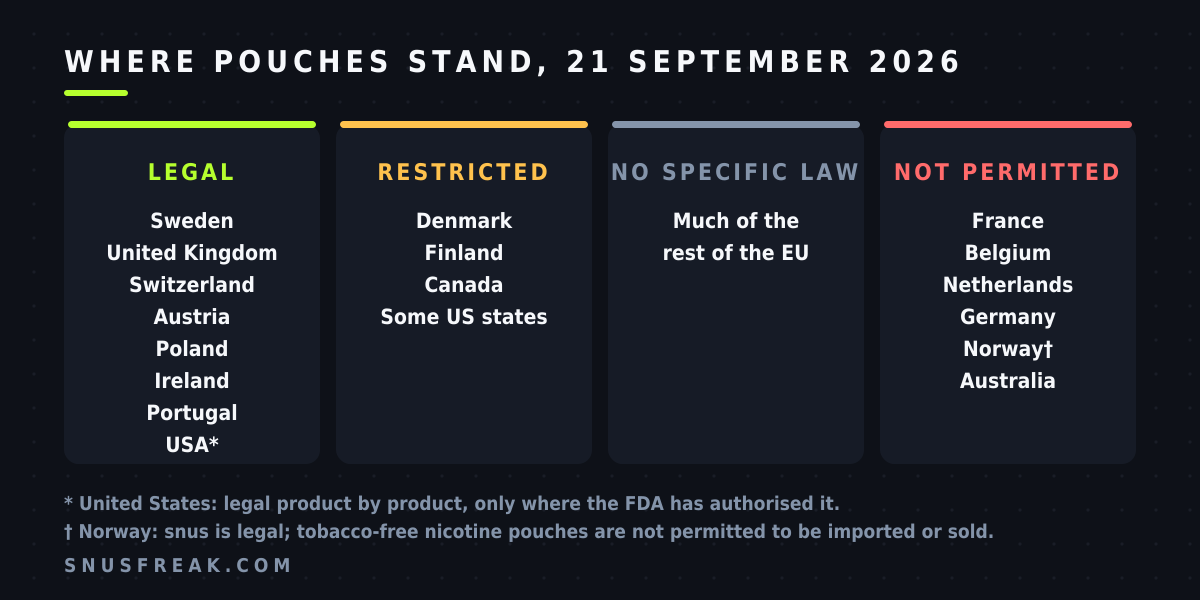
Legal means sale to adults is permitted. It does not mean unregulated — nearly every jurisdiction here has an age limit, and most have labelling rules.
Restricted means sale is permitted but the range is cut, usually by a nicotine cap or a flavour rule. These are the rows most likely to change.
No specific law means no pouch-specific instrument exists and the product sits under a general regime. That is not the same as permitted: in Germany the general regime is food law, and the result is a prohibition.
Banned / not permitted means sale, and usually import, is prohibited. Possession is frequently treated differently from sale — France is the exception that reaches the consumer — so check the country entry rather than assuming.
One trap worth naming: nicotine caps are quoted in different units and are not comparable. Denmark’s 9 mg is per pouch. Finland’s 16.6 mg, Austria’s 16.6 mg and Poland’s 20 mg are per gram. Sweden has no cap at all.
What is worth watching
- UK commencement regulations. The Act passed, but the 18+ rule for pouches only starts on 29 October 2026, and flavour, packaging, display and any nicotine cap all depend on regulations not yet made.
- The French annulment case. The Conseil d’État has suspended part of the decree and the merits case is pending. The outcome decides whether the possession ban survives.
- The EU evaluation. The Commission has identified out-of-scope nicotine products as a gap. If a revision brings pouches inside the directive with a harmonised cap, a dozen national regimes collapse into one.
- Poland’s flavour bill. Sejm print 2362 would restrict pouches to tobacco flavour. Enactment status unconfirmed.
- Sweden’s proposed 12 mg/g cap. Recommended by a 2024 inquiry, still under consideration in the Government Offices as of July 2026.
- The FDA pilot. Fifteen further products were authorised between January and August 2026; each authorisation changes what may lawfully be sold.
Corrections made on 21 September 2026
This page previously stated, and now does not:
- that nicotine pouches are legal in Norway — the Directorate of Health states they may not be imported or sold;
- that Germany is a grey area — placing them on the market is prohibited under food law, per the Bundestag’s own research service and settled case law;
- that the UK’s generational sale ban applies to pouches, and that a 20 mg cap is expected — neither is in the Act; pouches get a flat 18+ rule which is not yet in force;
- that Austria restricts sale to licensed tobacconists and applies excise — not established in the 2026 amending act;
- that Ireland approved a bill in March 2026 — the Bill is not enacted;
- that Portugal introduced a €0.065/g excise — no such category exists in the tax authority’s schedule;
- that Poland is unregulated with a flavour ban merely proposed — an express pouch law has been in force since July 2025;
- that Canada applies a 4 mg cap — it is a prescription threshold;
- that Rhode Island and New York City flavour-restrict pouches, and that Louisiana and West Virginia levy per-pouch excise — none substantiated;
- that a TPD3 draft was expected mid-2026 — no proposal date is confirmable.
Sources previously used on this page included trade press and retailer summaries. Those have been replaced throughout with regulators, statutes and official gazettes. Every link above is dofollow by design — they are government and regulator documents, and they are the point of the page.