

Nicotine pouches are labelled in milligrams per pouch; snus is labelled in milligrams per gram. They are different measurements, they are not interchangeable, and neither one tells you how much nicotine you will actually absorb. This guide explains what the number means, how to convert between the two, and how to pick a strength that does not ruin your afternoon.
If you do not already use nicotine, do not start. This page is for people who already do.
The two scales, and why they get confused
mg per pouch is what almost every nicotine pouch uses. A can marked 6 mg means each individual pouch contains six milligrams of nicotine. Simple, and the reason the industry adopted it: it is the number that means something to a consumer.
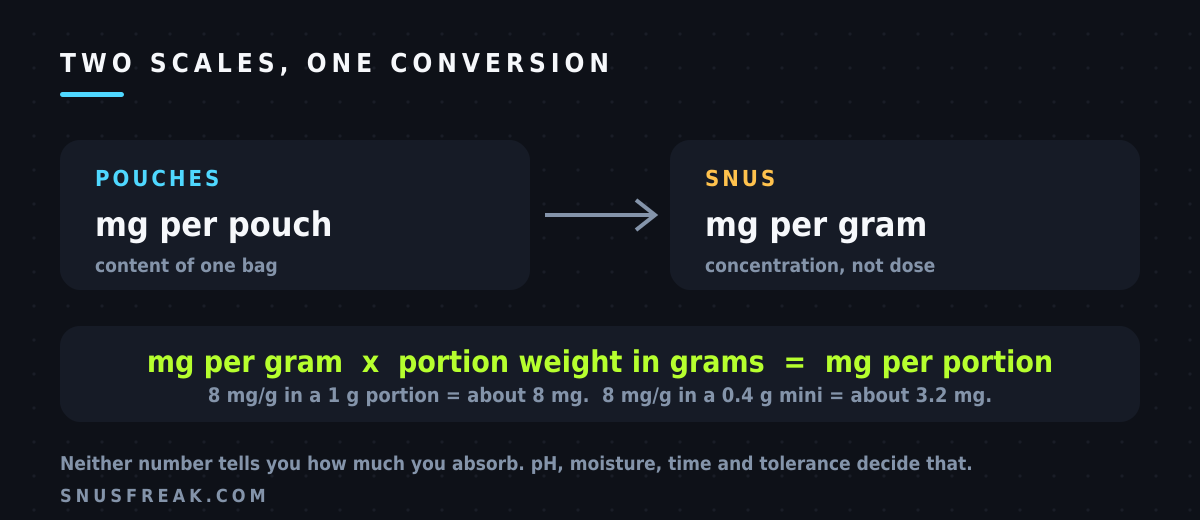
mg per gram is what snus uses, and what a few European pouch brands still print alongside. It tells you concentration, not dose. An 8 mg/g product in a 1 g portion holds roughly 8 mg; the same 8 mg/g in a 0.4 g mini holds roughly 3.2 mg.
To convert, multiply the mg/g figure by the portion weight in grams. That is the whole calculation. The trap is that portion weights are rarely printed on the front of the can, so people compare an 8 mg/g snus against an 8 mg pouch and assume they are equivalent. Depending on the portion weight, they may not be close.
Content is not dose
Here is the part that matters more than the arithmetic. The number on the can is how much nicotine is in the product. How much reaches your bloodstream is a different question, and it depends on four things the label does not tell you.
- pH. The higher the pH, the more of the nicotine is in its freebase form, and freebase nicotine crosses the lining of your mouth far more readily. This is the single biggest variable. Two products with identical mg can differ substantially in how much they actually deliver, purely because one is formulated more alkaline.
- Moisture. A moist pouch starts releasing within a minute. A dry one takes ten. Over a thirty-minute session the moist one will have handed over more.
- Time. Most of the delivery happens in the first thirty minutes. Keeping a pouch in for ninety minutes does not double anything.
- Your own tolerance. A 6 mg pouch is a pleasant lift to one person and an unpleasant head rush to another, on the same day.
The practical consequence: treat the mg figure as a rough band, not a dose. Compare products by how they feel over a few days, not by their labels.
The bands, as the market actually uses them
| Band | Pouches | Snus equivalent | Who it suits |
|---|---|---|---|
| Light | 3–4 mg | ~4–6 mg/g | A first pouch, or the last step of a taper |
| Mainstream | 6–8 mg | ~8–10 mg/g | Most people switching from cigarettes |
| Strong | 9–11 mg | ~11–14 mg/g | Established users, heavier former smokers |
| Extra strong | 12–16 mg | ~17–22 mg/g | High tolerance. The burn becomes a factor here |
| Extreme | 20 mg and above | 24 mg/g and above | Marketed as a challenge. Treat it as one |
The snus column is approximate and assumes a standard 1 g portion. It is a guide for switching, not a conversion you should rely on.
How many cigarettes is one pouch?
This question gets asked constantly and it does not have a clean answer, so here is the honest version.
A cigarette contains roughly 10–12 mg of nicotine, but a smoker absorbs only about 1–2 mg of it. So by absorbed dose, a 6 mg pouch is potentially delivering more nicotine than a single cigarette — but far more slowly, and without the sharp arterial spike that inhalation produces. That spike is a large part of what makes cigarettes so reinforcing.
The useful comparison is not per unit but per day. If you smoked twenty a day, you were absorbing somewhere around 20–40 mg. Matching that with pouches usually means eight to twelve mainstream-strength pouches, which is where most switchers land.
Picking a starting strength
- Heavy smoker, twenty or more a day: start at 6–8 mg. Going lower usually means you top up constantly and get frustrated.
- Light or social smoker: 3–4 mg. You will be surprised how much a pouch delivers compared to an occasional cigarette.
- Coming from vaping: depends entirely on what you were vaping. If you were on 20 mg/ml salts all day, treat yourself as a heavy user and start at 6–8 mg.
- Coming from snus: take your usual mg/g, multiply by portion weight, and pick the pouch band nearest that number. Expect the pouch to feel slightly cleaner and slightly faster.
- Never used nicotine: do not start.
The rule I would give anyone: start one band lower than you think you need. Climbing up is trivially easy. Coming back down after your tolerance has risen takes weeks.
Strength creep, and how to stop it
Tolerance builds. The 6 mg that gave you a lift in month one gives you nothing in month six, and the obvious move is to buy 11 mg. Do that twice and you are on 16 mg wondering how you got there.
What actually works is holding your strength fixed and letting the frequency float, rather than the other way round. If a band stops doing much, take two or three days at a lower strength before going back — tolerance drops faster than most people expect. And if you find yourself shopping in the extreme tier, that is worth noticing as a signal rather than a preference.
When a strength is too high
Too much nicotine at once feels like: a racing or pounding heart, sweating, nausea, dizziness, sometimes hiccups, and a distinctly unpleasant clamminess. It is unmistakable.
Remove the pouch immediately, rinse your mouth, sit down and drink water. It passes, usually within twenty to thirty minutes, and it is not typically dangerous in an adult — but it is your body telling you plainly that you misjudged the dose. Nicotine is genuinely dangerous to children and pets, which is a separate and much more serious matter: keep cans out of reach.
Frequently asked questions
Why do two 6 mg pouches from different brands feel so different?
pH, moisture and fleece. The label describes content; those three describe delivery.
Does a bigger pouch mean more nicotine?
Not necessarily. A large pouch at 6 mg and a slim pouch at 6 mg hold the same nicotine. The large one has more filler around it.
Does keeping it in longer give more nicotine?
Up to a point. The bulk of delivery is in the first thirty minutes; after an hour you are mostly holding a used pouch.
Is there a legal maximum?
It varies. Finland caps at 16.6 mg/g, Denmark at 9 mg per pouch, and the UK is moving toward a 20 mg cap. There is no federal cap in the US.