Caffeine pouches: the complete guide
Caffeine pouches hold 20 to 100 mg each - the spread between brands is enormous. How they compare with coffee, where the daily ceiling sits, and why the format makes it easy to overshoot.


A caffeine pouch is the same format as a nicotine pouch with caffeine in place of nicotine, typically 20 to 100 mg per pouch. It is absorbed partly through the lining of the mouth and partly by swallowing, which makes it faster than a coffee but not instant. There is no nicotine and no addiction risk of the nicotine kind — but caffeine has its own ceiling, and these make it very easy to overshoot.
How much caffeine is actually in them
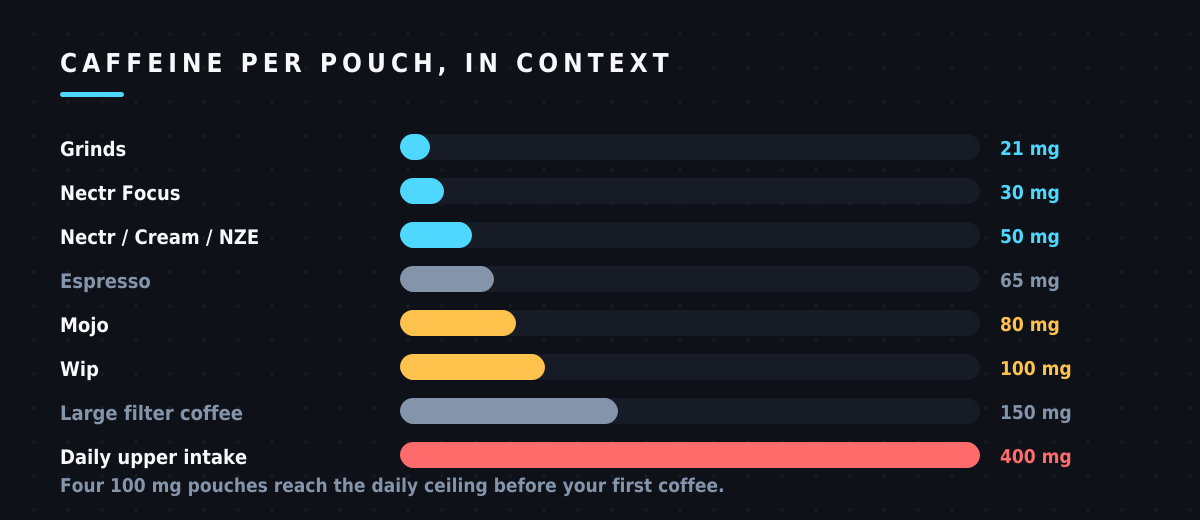
Brands vary enormously, far more than nicotine pouches do. For context, a standard espresso is roughly 65 mg and a large filter coffee around 150 mg.
| Product | Caffeine per pouch | Other actives |
|---|---|---|
| Grinds | ~21 mg | — |
| Nectr Focus | 30 mg | Citicoline |
| Nectr Energy | 50 mg | — |
| Cream Energy | 50 mg | — |
| NZE | 50 mg | L-theanine, Alpha-GPC, L-tyrosine |
| Mojo | 80 mg | B vitamins |
| Wip | ~100 mg | — |
Figures as published by the manufacturers. Comparison source.
The spread matters. Two Wip pouches is roughly a large filter coffee. Two Grinds is barely half an espresso. Reading the number before you buy is not optional in this category.
How they feel compared with coffee
Faster onset than a drink, because some absorption happens through the oral mucosa rather than waiting on the stomach. Less of a spike than an energy drink, because there is no sugar. And no acidity, which is the reason a lot of people switch — caffeine without the stomach consequences.
The onset is not instant. Expect five to ten minutes for something noticeable, versus twenty to forty-five for coffee. Duration is broadly similar, three to five hours, governed by caffeine’s half-life rather than by the format.
The ceiling, and why it is easy to miss
Health authorities generally put the safe upper intake for a healthy adult at around 400 mg of caffeine a day. Four Wip pouches is at that line before you have had a single coffee.
The format is the problem. Pouches are easy — no cup, no queue, no waiting. That convenience makes it far easier to accumulate caffeine without noticing than it is with coffee, where each unit takes effort. Too much caffeine gives you jitters, a racing heart, anxiety and disturbed sleep, and the sleep effects last longer than most people believe: caffeine’s half-life is around five hours, so an evening pouch is still half in your system at midnight.
Count them the way you would count coffees.
The functional category
A growing slice of the market pairs caffeine with other compounds. L-theanine is the most common and the best-supported — it takes the edge off caffeine’s jitteriness without reducing alertness. Alpha-GPC and citicoline appear in “focus” formulations. B vitamins are common and largely marketing; most people are not deficient. Paraxanthine, a caffeine metabolite, is the newest entrant.
Be sceptical of the claims on these cans. The dosing is often well below what the underlying research used, and “nootropic” is not a regulated term.
Who they actually suit
- People who want the pouch ritual without nicotine. This is the biggest genuine use case — including people stepping away from nicotine who miss the habit rather than the drug.
- Training and sport. No liquid, no volume, no stomach load.
- Anyone who reacts badly to coffee acidity.
- Long drives and late shifts, where the convenience is the whole point.
Who they do not suit: anyone sensitive to caffeine, anyone with a heart condition or high blood pressure without medical advice, anyone pregnant, and anyone under 18.
Frequently asked questions
Are they addictive?
Caffeine produces dependence and withdrawal — headaches, irritability, fatigue — but not the kind of addiction nicotine produces. It is a real effect and a much milder one.
Can you use one with a nicotine pouch?
People do. Both raise heart rate, so the combined effect is more than either alone. Start with one.
Do you swallow the saliva?
Yes, and in this case it matters — a meaningful share of the caffeine is absorbed in the gut rather than the mouth.
How long do you keep one in?
Most brands suggest 20 to 30 minutes. After that you are holding an empty bag.