

A nicotine-free pouch is an oral pouch you park under your lip that contains no nicotine and no tobacco — sometimes nothing active at all, sometimes caffeine, sometimes a “functional” ingredient. Legally it is food, not a tobacco product, which is why almost no country age-restricts it. The striking thing about the category is how little published evidence exists: on absorption, on oral health, and on whether it helps anyone quit.
This is the hub for everything on this site about pouches that leave the nicotine out. It covers what is in them, what the law makes of them, what the science actually says — and, more often than I expected when I started reading, what the science does not say at all.
What a nicotine-free pouch is
The format is borrowed wholesale from white snus. A small fleece or non-woven sachet, roughly 0.4 to 0.9 grams, sits between the upper lip and the gum for twenty minutes to an hour. Saliva wets it, and whatever is in the pouch comes out into the mouth. Take the nicotine out of a nicotine pouch and the delivery system is unchanged; only the payload differs.
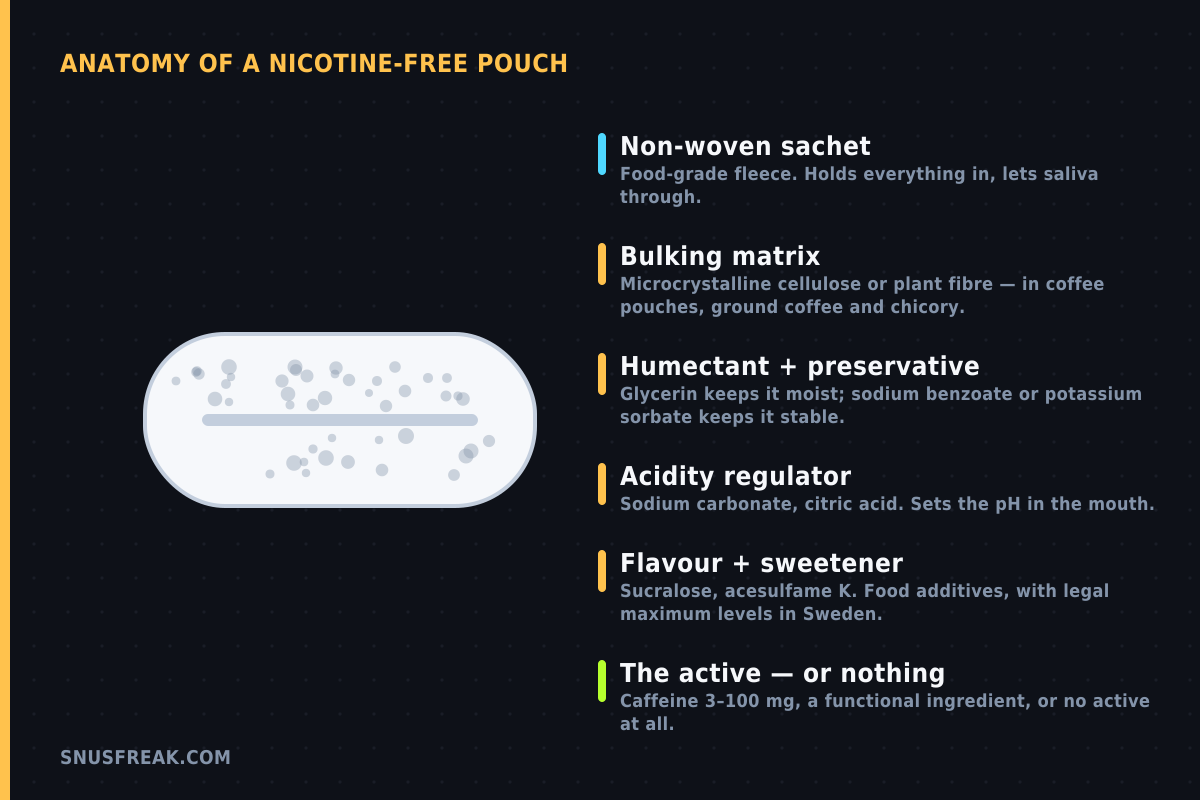
What is inside varies more than the marketing suggests. The German federal risk assessment institute, the BfR, describes the carrier used in nicotine pouches as nicotine salts combined with “mikrokristalliner Zellulose, verschiedenen Salzen (z. B. Natriumcarbonat und -hydrogencarbonat), Zitronensäure und Aromen” — microcrystalline cellulose, various salts such as sodium carbonate and bicarbonate, citric acid, and flavourings. BAT describes its own modern oral pouches as containing “high-purity nicotine, water and other high-quality food-grade ingredients, including plant-based fibres, flavouring and sweeteners.”
Both of those describe pouches that do contain nicotine. I could not find a regulator anywhere that has published a composition assessment of a nicotine-free pouch. What we have instead are manufacturers’ own ingredient declarations, and they show that the cellulose-carrier model is not universal. The US brand Grinds, which makes coffee pouches, declares its Black Coffee product as “Coffee, Water, Glycerin, Chicory, Espresso, Natural & Artificial Flavor, Energy Blend (Caffeine, B-Vitamins,Taurine, Glucuronolactone), Salt, Sucralose, Sodium Benzoate” — ground coffee and chicory as the bulking matrix, not cellulose at all.
What recurs across declarations is the supporting cast rather than the active: a humectant to stop the pouch drying out (glycerin), a preservative (sodium benzoate, potassium sorbate), a pH or acidity regulator (sodium carbonate, citric acid), and high-intensity sweeteners (sucralose, acesulfame K). Those are food additives, and that is not an accident — as the next section explains, food law is exactly what governs these products.
The three families
It helps to separate three things that get lumped together.
Plain nicotine-free pouches carry flavour and nothing else active. They exist to give you the ritual — the lip bulge, the tingle, the twenty-minute rhythm — without the drug. Swedish regulation has a name for this category: snusliknande produkter utan nikotin, snus-like products without nicotine.
Caffeine and energy pouches carry a stimulant dose. Grinds states that its coffee pouches contain “3mg, 25mg, 50mg, or 100mg of caffeine per pouch, depending on the specific flavor” and that its energy pouches contain 80 mg. The Swedish Food Agency, in its 2026 advice on caffeine for children and young people, lists “vitt nikotinfritt snus med koffein” — white nicotine-free snus with caffeine — as a caffeine source at “20–100 mg Per portionspåse”, 20 to 100 mg per portion pouch. That is a government source confirming the dose range on the market.
Functional pouches carry something else again: vitamins, L-theanine, ashwagandha, creatine, electrolytes, melatonin. This is where I have to be blunt about the limits of what I could verify. I could not obtain a manufacturer ingredient declaration for a single one of those, and nothing on this page substantiates the composition, dose or legality of a melatonin or ashwagandha pouch. Melatonin in particular has sharply different legal status as a food ingredient in the US, the UK and individual EU states, and anyone selling one across borders is navigating a problem they may not have noticed.
In law, these are food
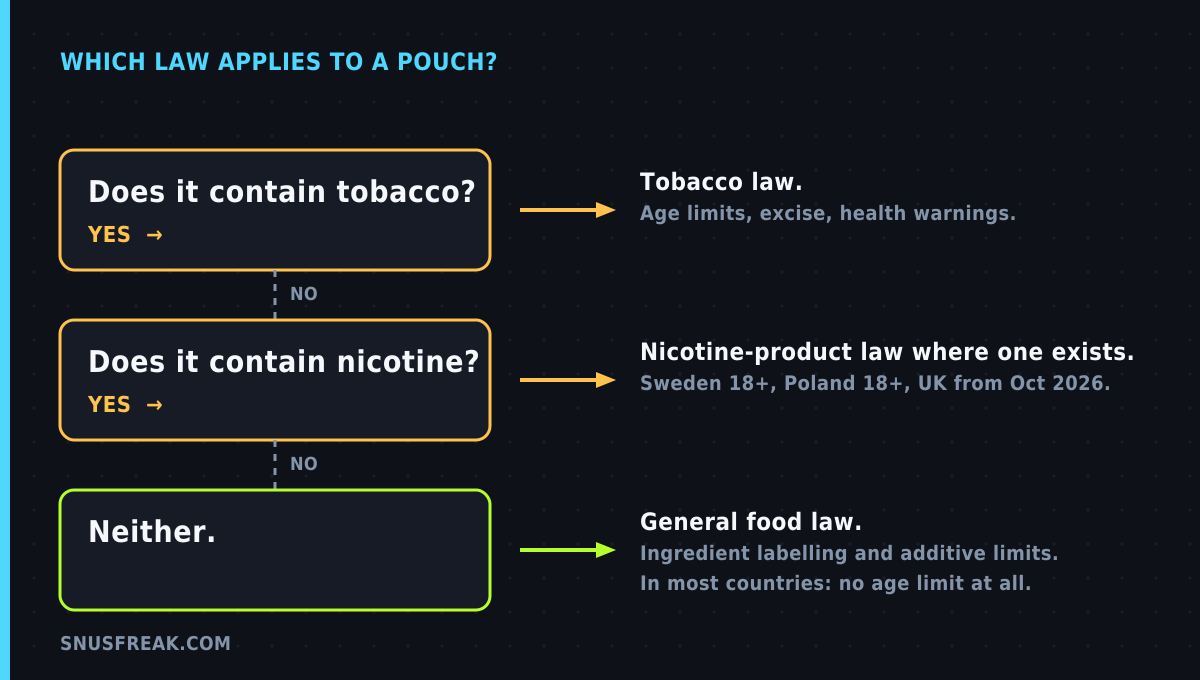
This is the part that surprises people. A pouch with no tobacco and no nicotine fails the definition of a tobacco product, and fails the definition of a nicotine product, in essentially every instrument that regulates pouches. What is left is general food law.
Sweden is the only country I found that regulates them explicitly, and it does so through its food agency. LIVSFS 2024:2, in force since 1 April 2024, covers “snus, snusliknande produkter och tuggtobak”. Its section 14 deals with the nicotine-free case directly: “Förpackningar med snusliknande produkter utan nikotin, som levereras direkt till konsument, ska förses med en förteckning över alla ingredienser som ingår i produkten i fallande viktordning” — packages of snus-like products without nicotine supplied direct to consumers must carry a full ingredient list in descending order of weight. The regulation sets permitted food additives with maximum levels (acesulfame-K at 4 g/kg, saccharin at 2.5 g/kg) and contaminant limits for lead, aflatoxins and benzo(a)pyrene. It sets no age limit.
Sweden’s actual nicotine law, Lag (2022:1257) om tobaksfria nikotinprodukter, defines its subject as “en produkt utan tobak som innehåller nikotin för konsumtion” — a product without tobacco that contains nicotine. Its 18-year age limit at section 19 therefore does not reach a pouch with no nicotine in it.
The same structural point holds elsewhere. The UK’s Tobacco and Vapes Act 2026, which received Royal Assent on 29 April 2026, defines a “nicotine product” at section 51 in four limbs, every one of which requires nicotine: a device intended to deliver nicotine, a part of such a device, “nicotine, or any substance containing nicotine, which is intended to be delivered into the human body”, or an item containing that. Its “tobacco product” definition requires tobacco, and its “herbal smoking product” definition requires something “intended to be smoked”. A caffeine pouch is none of those. Reading the definitions, I see no route by which the Act reaches it — though I should say that is my reading of the sections, not something the Act states expressly.
Poland’s pouch law of 21 May 2025 (Dz.U. 2025 poz. 799) defines its pouch category as a product containing nicotine, while separately extending the Act to nicotine-free e-cigarettes and nicotine-free refill liquids — the drafters plainly considered zero-nicotine versions and chose to cover vapes but not pouches. I could only reach that Act in unofficial translation, so I am summarising rather than quoting it; the position is set out with its sources in our regulation tracker. Spain’s draft Royal Decree notified to the Commission in January 2025 follows the identical pattern: it creates a nicotine pouch category and separately covers nicotine-free electronic cigarettes.
In the EU generally, the question is whether a given ingredient is a novel food under Regulation (EU) 2015/2283 — food “not used for human consumption to a significant degree within the Union before 15 May 1997”. That test turns on the ingredient, not the format, which is why nicotine pouches ran into it and caffeine pouches largely have not: caffeine has an obvious pre-1997 history of food use. The Commission is explicit that its novel food catalogue is “a non-binding tool” and that “it is up to the Food Business Operator… to be able to prove a history of consumption as foodstuff before 15 May 1997.”
In the United States, a product with no tobacco and no nicotine is outside the FDA’s tobacco authority entirely. What I could not establish is what it is instead — I found no FDA document stating whether a caffeine or functional pouch is a conventional food, a dietary supplement, or neither. The closest relevant text is FDA’s 2018 guidance on highly concentrated caffeine in dietary supplements, which treats premeasured single-dose formats favourably because they “eliminate the need for a consumer to accurately measure”. That is suggestive, not a classification, and I am not going to assert one.
Nobody age-restricts them
Follow the definitions through and you land somewhere uncomfortable. I could not find a single jurisdiction that has age-restricted or banned nicotine-free pouches as such. The UK Act, the Polish law, the Spanish draft and the Swedish nicotine act all define their restricted category by the presence of nicotine. Sweden regulates nicotine-free pouches as food, with labelling and additive rules but no minimum age.
That means a 100 mg caffeine pouch — more caffeine than a cup of coffee, in a format designed to be held in the mouth — is, in most of the world, a product a child can legally buy. Sweden’s food agency has noticed. Its 2026 advice says “Ungdomar under 16 år bör inte konsumera mer än 70 milligram koffein per dag”: young people under 16 should not consume more than 70 mg of caffeine a day, and “Barn under 6 år bör undvika koffein helt”, children under 6 should avoid caffeine entirely. It concludes that “En lämplig ålder för begränsande råd om koffein bedöms vara 16 år.”
A single 100 mg pouch exceeds that entire daily advisory ceiling for an under-16. But advice is not a sales restriction, and I found no country that has turned it into one. If you want a candidate for the next regulatory gap to close, this is it.
What the safety bodies say about caffeine
The caffeine figures themselves are well established, and they are the numbers to use — as long as you remember what they were derived for.
| Threshold | Figure | Body |
|---|---|---|
| Single dose, healthy adult | Up to 200 mg “do not raise safety concerns” | EFSA (2015); echoed by UK FSA |
| Daily total, healthy adult | Up to 400 mg “do not raise safety concerns” | EFSA; FDA |
| Pregnancy, daily | Up to 200 mg “do not raise safety concerns for the fetus” | EFSA |
| Children and adolescents | 3 mg/kg body weight per day | EFSA |
| Under-16s (national advice) | No more than 70 mg/day | Livsmedelsverket (2026) |
| Acute toxic effects | Around 1,200 mg, rapidly consumed | FDA |
Set the 200 mg single-dose figure against a 100 mg pouch and the arithmetic is straightforward: two pouches in quick succession puts an adult at the single-dose threshold, with whatever coffee they have already had that day on top.
Here is the caveat that matters, and it is a real one. Neither EFSA nor the FDA has assessed caffeine delivered through the lining of your mouth. Every figure above is for caffeine “from all sources” by ordinary dietary exposure — drunk, eaten, swallowed. Whether a pouch produces the same blood curve as a coffee is precisely the question nobody has answered.
The absorption claim has no study behind it
Search the published literature for pharmacokinetic work on caffeine delivered from an oral pouch and you find nothing. No Tmax, no Cmax, no bioavailability figure, no comparison against swallowed caffeine. A PubMed search for caffeine pouches returns exactly one indexed item, and it is a short news piece in the BMJ, not original research.
This matters because the category’s central marketing claim is about absorption — that pouch caffeine hits faster, or works better, because it goes through the buccal mucosa rather than the gut. I would not put much faith in that claim as things stand. It is not that the evidence is mixed; it is that there is no evidence.
The adjacent literature, such as it is, points the other way. A 2025 study of sublingual caffeine spray found that sublingual delivery did not accelerate the rise in blood caffeine compared with ingestion. Caffeinated chewing gum and oral dissolving films have been studied; pouches have not. The one thing we do know about the format comes from nicotine research: a 2024 randomised cross-over study of tobacco-free nicotine pouches in Psychopharmacology found nicotine peaking at 30 to 38 minutes, slightly faster than snus or nicotine gum at 45 minutes. Nicotine is not caffeine and you cannot transfer the number, but it at least establishes that the format delivers something through the mucosa on a measurable timescale.
What they do to your mouth is unstudied
The same hole appears here. A critical review of oral health risks published in the Harm Reduction Journal on 31 December 2024 examined 52 studies and noted that “In two studies ONPs and in one study HTPs were investigated” — two studies on nicotine pouches out of 52. The authors add that “Since ONPs have the most intensive contact with the oral mucosa, future studies on the oral health effects of this product are of particular importance.” If the evidence on nicotine pouches is that thin, the evidence on nicotine-free ones is thinner still: I found none at all.
That cuts both ways, and it is worth being even-handed about it. There is no published finding that nicotine-free pouches harm your gums. There is also no published finding that they do not. The claim you sometimes see — that they are “gentler” because there is no nicotine — is untested. The additives are still there, held against the mucosa for twenty minutes or more, several times a day.
Do they help you quit? Nobody knows
The pitch is intuitive: if the habit is partly ritual, a pouch with no drug in it lets you keep the ritual and drop the drug. Grinds says its coffee pouches “were originally designed to help smokeless tobacco users kick their habit” and describes them as “a great way to simulate the oral fixation that accompanies chewing tobacco.”
That is a manufacturer’s claim, and I could find no published trial testing it. Not a positive trial, not a negative one — nothing. No medicines regulator anywhere has authorised a nicotine-free pouch as a cessation aid, and nothing on this site should be read as saying any pouch is a treatment for stopping.
For context on what the evidence does cover, the Cochrane review of oral nicotine pouches for cessation, published 24 October 2025, looked at four studies and 284 smokers and concluded there is “limited evidence on the use of ONP for cessation or reduction of cigarette use”, that “low-certainty evidence suggests that people randomised to ONP may be slightly less likely to quit smoking than those randomised to e-cigarettes”, and that “more research on the effects of ONP for cessation or reduction of use of other tobacco or non-pharmaceutical nicotine products is urgently needed.” That review is about nicotine pouches. It does not evaluate nicotine-free ones, and it does not use them as a comparator. Our own piece on quitting smoking with pouches goes through that evidence in detail.
Who actually makes them
Not, on the evidence of their own filings, the big two. Philip Morris International’s 2025 annual report, filed with the SEC on 10 March 2026, reports total oral smoke-free volume of 20.7 billion units and says “Total oral smoke-free shipment volume in pouches or pouch equivalents increased versus the prior year by 18.5%, driven by nicotine pouches, which grew by 36%.” It contains no mention of nicotine-free, caffeine or functional pouches at all. BAT’s 2024 modern oral document describes only nicotine-containing products.
So the category belongs to independents. Grinds is the clearest documented example, and the Swedish food agency’s 2026 report confirms caffeine pouches are on open sale in Sweden across a 20 to 100 mg range. Beyond that, I have no company-level revenue or volume figure for this category from any filing, because the companies that publish filings do not appear to participate in it. Treat any market-size number you see quoted elsewhere with suspicion unless it names its source.
Recalls and enforcement
I queried the FDA’s food enforcement database directly for caffeine-related recalls. Twelve records came back — mislabelled energy drinks, a decaf coffee mix-up, one energy drink that “Contains 300mg of caffeine, instead of 150mg as provided on can” — and none of them involves an oral pouch. A search of FDA warning letters turned up nothing sent to a caffeine-pouch or functional-pouch company. I could not check the EU’s RASFF portal, which runs as a JavaScript application and would not open, so I cannot say anything either way about European notifications.
An absence of recalls in a young, lightly regulated category is not the same as a clean safety record. It may simply mean nobody is looking.
How to read a pouch tin
Since there is no authority vetting these products the way tobacco regulators vet nicotine pouches, the label is most of what you have. A few things worth checking.
- Is the caffeine dose stated per pouch? A tin that gives a figure per can, or no figure at all, is telling you something about how carefully it was put together.
- Is there a full ingredient list in descending weight order? Swedish law requires it for direct-to-consumer sales; a seller who does not provide it is at best outside best practice.
- Does the pack claim a health or cessation benefit? No such claim has been authorised by any regulator I could find.
- Does it claim faster or better absorption? No published study supports that for caffeine in this format.
- Who is the food business operator? Under EU and UK food law there has to be a named, addressable one on the pack.
Where this fits
If you came here from the nicotine side of the site, the useful companions are nicotine pouches explained for how the format works with a drug in it, the strengths guide for what the milligram numbers mean, and the global regulation tracker for where each country stands. For the caffeine sub-category in depth, see caffeine pouches: the complete guide. Terminology is in the glossary.
Frequently asked questions
Are nicotine-free pouches safe?
No product is safe, and I am not in a position to tell you these are. What I can tell you is that almost nothing has been published about their effects — no oral health studies, no absorption studies — so anyone who tells you they are safe is going beyond the evidence in one direction, and anyone who tells you they are dangerous is going beyond it in the other.
Can under-18s legally buy them?
In most places, yes, because the laws that restrict pouches all require nicotine. Sweden’s food agency advises that under-16s should not exceed 70 mg of caffeine a day, which a single strong pouch exceeds, but that is advice rather than law.
Will a caffeine pouch hit faster than coffee?
Nobody has published a study measuring it. The one adjacent study on sublingual caffeine found no acceleration compared with swallowing.
Do they show up as tobacco products on a drug test or at customs?
They contain no nicotine and no tobacco, so tobacco-specific rules do not apply to them. Customs treatment varies with national food rules, and some countries restrict specific functional ingredients — melatonin most commonly.
Will they help me get off nicotine pouches?
There is no published trial on that, in either direction, and no regulator has authorised any nicotine-free pouch as a cessation aid. If stopping nicotine is your goal, that is a conversation worth having with a doctor or a stop-smoking service rather than with a tin.
Are they legal to post internationally?
They travel as food rather than as tobacco, which usually makes them easier — but food rules bite on specific ingredients, and a pouch containing melatonin or a botanical extract can be refused entry where a caffeine one sails through.
Sources
- LIVSFS 2024:2, Livsmedelsverket’s regulations on snus, snus-like products and chewing tobacco, in force 1 April 2024 (section 14 on nicotine-free products; additive and contaminant limits).
- Lag (2022:1257) om tobaksfria nikotinprodukter, 30 June 2022 (definition at § 3, age limit at § 19).
- Livsmedelsverket, L 2026 nr 05, Råd om koffein till barn och ungdomar (2026) — caffeine pouch dose range and the under-16 advice.
- Tobacco and Vapes Act 2026 (c. 18), section 51, and the Act as enacted, Royal Assent 29 April 2026.
- FSA/FSS, Guidance for food business operators on food supplements containing caffeine, 25 September 2024.
- Regulation (EU) 2015/2283 on novel foods, adopted 25 November 2015 (Articles 3 and 6).
- European Commission, Novel Food status catalogue.
- BfR, Gesundheitliche Bewertung von Nikotinbeuteln, updated opinion 023/2022, 7 October 2022 (carrier composition).
- Deutscher Bundestag, Wissenschaftliche Dienste, WD 5-3000-002/23, 16 January 2023 (food-law treatment in Germany).
- EU TRIS notification 2025/0044/ES, 24 January 2025 (Spanish draft Royal Decree scope).
- FDA, Guidance for Industry: Highly Concentrated Caffeine in Dietary Supplements, April 2018.
- FDA, Spilling the Beans: How Much Caffeine is Too Much?, 28 August 2024.
- EFSA Scientific Opinion on the safety of caffeine, EFSA Journal 2015;13(5):4102.
- Characterization of the nicotine uptake and safety of Nordic spirit tobacco-free oral nicotine pouches, Psychopharmacology, 23 November 2024.
- Oral health risks in adults who use electronic nicotine delivery systems and oral nicotine pouches, Harm Reduction Journal 21:229, 31 December 2024.
- Cochrane, Oral nicotine pouches for cessation or reduction of use of other tobacco or nicotine products, 24 October 2025.
- Philip Morris International 2025 Annual Report, filed 10 March 2026.
- BAT, Our Modern Oral Products, 2024.
- Grinds Coffee Pouches, ingredient declarations, 19 December 2023, and Grinds FAQ (caffeine doses, cessation claim).
Last verified: 23 September 2026.